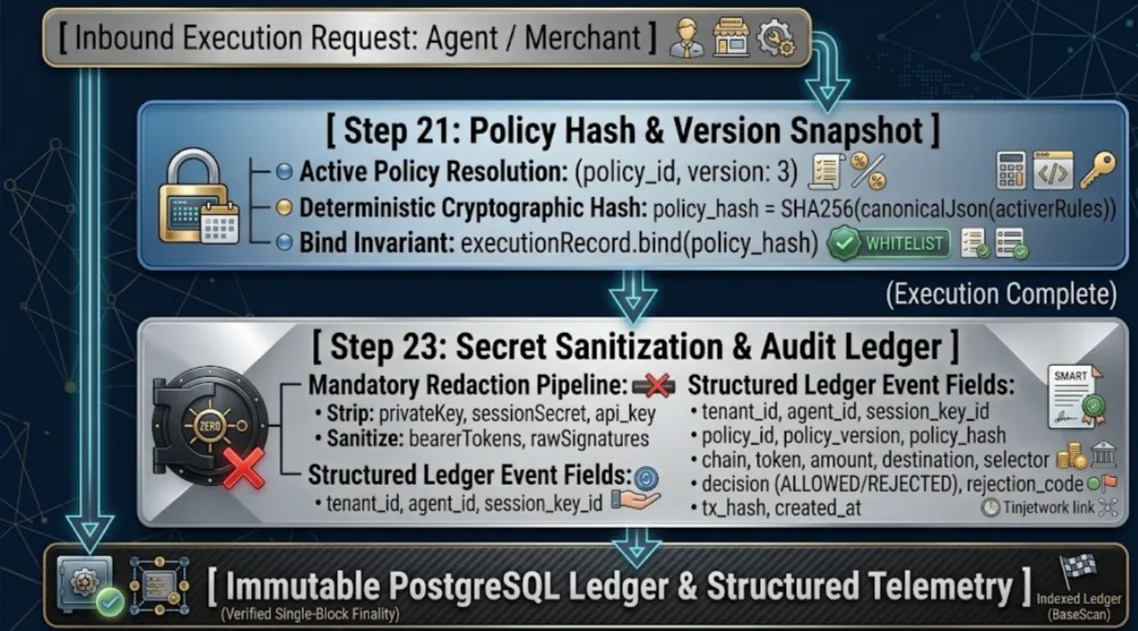
When autonomous AI agents execute financial transactions at machine speed, post-execution observability is not an optional debug feature—it is the authoritative record of accountability. If an autonomous agent triggers an unexpected state change or executes an edge-case payment link, engineering and compliance teams must be able to deterministically answer: Under what exact policy version did this transaction pass? What was the decision pipeline state? And who authorized the parameter boundary?
However, naive logging systems introduce a catastrophic vulnerability: credential and secret leakage.
In unstructured logging pipelines, capturing full request contexts often dumps session private keys, merchant API secrets, customer authorization headers, and webhook signing tokens straight into third-party observability hubs (e.g., Datadog, CloudWatch, or Logstash). Once logged, these secrets become accessible to unauthorized team members or vulnerable to telemetry breaches.
To provide tamper-proof provenance without exposing sensitive material, production-grade infrastructure enforces Deterministic Policy Hash Versioning and Zero-Secret Structured Telemetry.
A zero-leak audit and telemetry architecture operates across three non-negotiable principles:
Immutable Policy Versioning & Cryptographic Policy Hashes:
Policies must never be updated via in-place state mutation. If a merchant or operator modifies a spending ceiling from $50 to $100, the system drafts a new immutable version (version: 4). Every execution ledger entry records policyid, policyversion, and a deterministic policyhash (the SHA-256 hash of canonicalized policy constraints). Historical transactions remain forever provable against the exact rule configuration in place at execution time.
Deterministic Secret Sanitization at the Driver Layer:
Sanitization cannot rely on developer discipline or ad-hoc string filtering. The audit logger implements a recursive interceptor that sanitizes payloads at the database driver boundary:
// Hard boundary: Redact sensitive credentials
const SANITIZEDKEYS = new Set([
'privatekey', 'sessionkeysecret', 'apisecret',
'webhooksecret', 'seedphrase', 'bearer_token'
]);
Any payload containing these keys replaces their values with [REDACTED] prior to serializing into audit tables or dispatching structured observability events.
Structured Telemetry Observers:
Platform monitoring relies on strongly typed events (agent.policy.allowed, agent.policy.rejected, agent.limit.exceeded, agent.selector.rejected). Telemetry systems receive exact quantitative metrics (rejection reasons, latency, gas consumption, rate-limit consumption) without ingesting payload bodies that could expose sensitive customer or business context.
Deterministic auditability bridges the gap between machine speed and institutional compliance: guaranteeing that every cent spent by an AI agent is fully explainable without compromising core operational secrets.