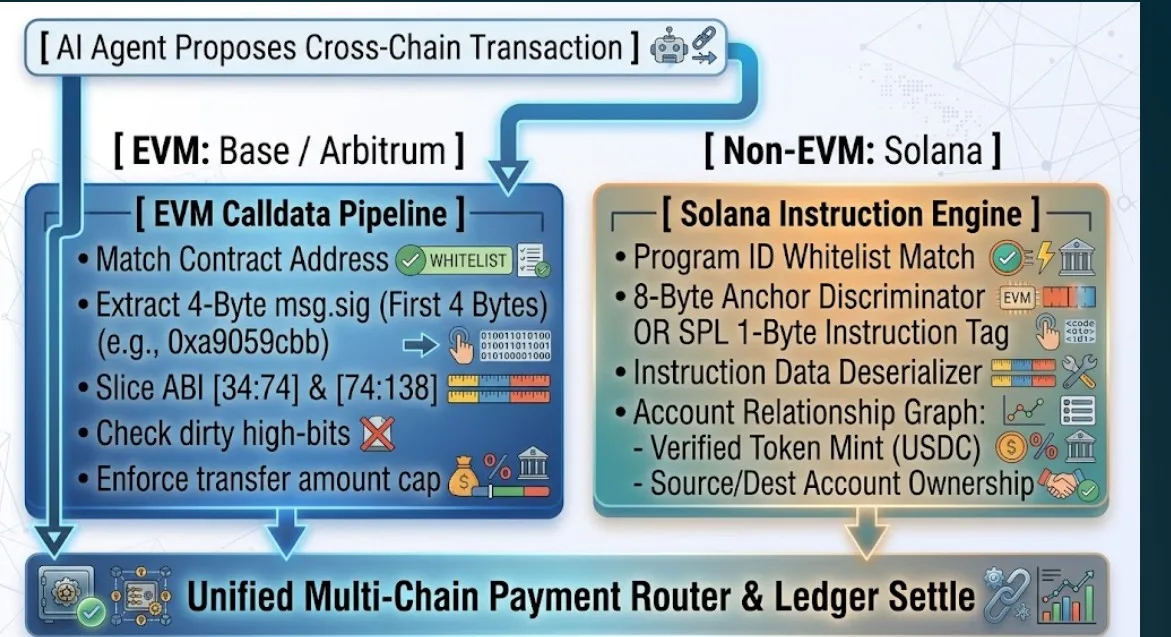
Over the earlier chapters of this architectural series, we demonstrated how extracting 4-byte function selectors (msg.sig) and decoding EVM calldata offsets prevents unauthorized operations on Ethereum and Base L2. This model works reliably because the EVM routes contract execution deterministically using standard ABI signatures.
However, treating all blockchains as EVM clones is a dangerous architectural mistake.
When autonomous AI agents interact with Solana, EVM selector parsing completely breaks down. Solana does not utilize 4-byte ABI method hashes, contract-held storage balances, or monolithic state calls. Instead, Solana enforces a stateless, account-centric model where instructions pass arbitrary instruction data alongside a list of explicit AccountMeta references (read-only vs. writable, signer vs. non-signer).
Applying zero-trust boundaries to Solana requires constructing a Non-EVM Instruction Policy Engine tailored to Solana's native runtime and Anchor frameworks.
A resilient cross-chain execution boundary enforces two distinct architectural patterns:
1.Program ID & Instruction Discriminator Validation:
Rather than looking for an EVM function selector, the Solana validation pipeline evaluates:
Program ID Matching: Ensures the targeted program matches canonical deployments (e.g., the SPL Token Program TokenkegQfeZyiNwAJbNbGKPFXCWuBvf9Ss623VQ5DA or verified Anchor programs).
Discriminator Extraction: For Anchor-based programs, the engine inspects the first 8 bytes of the instruction data (the sha256 hash of global:<instruction_name>). For native SPL programs, it verifies the explicit 1-byte instruction tag. Unregistered or arbitrary instruction data is rejected before signing.
2.Account Metadata & Relationship Traversal:
In EVM, a token contract manages its internal balance mapping. In Solana, balances live in discrete Associated Token Accounts (ATAs). A compromised agent could technically craft an allowed instruction (like TransferChecked) but route it to an arbitrary mint or untrusted token program. The policy engine traverses the account array to confirm:
The mint address strictly matches native Solana USDC (EPjFWdd5AufqSSqeM2qN1xzybapC8G4wEGGkZwyTDt1v).
The destination token account is properly derived and owned by the authorized recipient.
Signer privileges are not improperly escalated.
3.Graceful Fallbacks for Unknown Instructions:
If an agent proposes an instruction from a protocol where an IDL (Interface Definition Language) is unavailable or custom instruction data cannot be safely deserialized, the engine automatically fails closed: it either halts execution immediately or escalates the transaction directly into the Human-in-the-Loop (HITL) review queue.
True cross-chain infrastructure does not force non-EVM chains into EVM molds. Implementing runtime-native constraints guarantees that autonomous agents transact safely across both Base L2 and Solana.