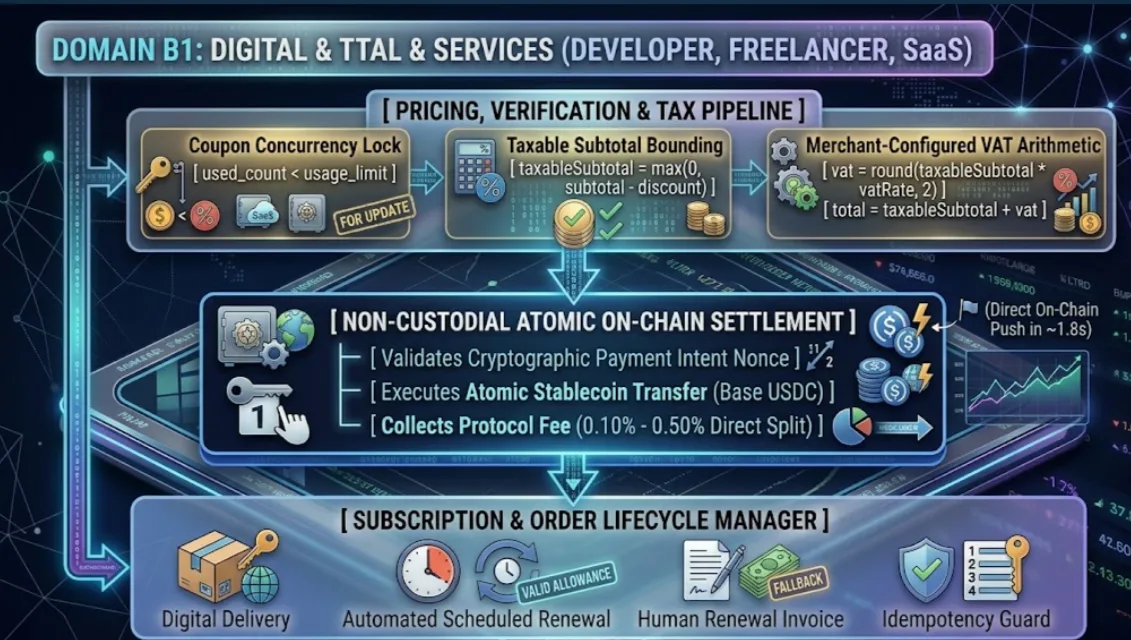
Yesterday, we established the Niche-Aware Capability Architecture that isolates physical counter checkouts from software workflows. Today, we dive into the engine powering digital commerce, SaaS builders, and online enterprises: The Digital Commerce Engine.
Accepting a one-off stablecoin transfer is trivial; building an industrial-grade digital commerce engine requires handling edge cases that break naive payment scripts. How do you prevent two concurrent shoppers from redeeming the last remaining discount code? How do you ensure localized tax math never produces a negative balance? And how do you handle recurring subscriptions on non-custodial blockchains where smart wallets cannot be arbitrarily drained by third parties?
The modern commerce lifecycle resolves these challenges through strict concurrency controls, mathematical bounding, and idempotent state transitions.
The digital commerce architecture enforces three mission-critical guarantees:
Race-Condition-Proof Coupon Redemption:
1.When a merchant issues a limited promotion (e.g., first 100 users get $20 off), standard read-then-write updates fail during traffic spikes. If the remaining usage is 1, multiple parallel requests can read usedcount = 99 and all redeem the discount. The engine executes coupon validation inside a database transaction with a row-level lock (FOR UPDATE). If usedcount + 1 > usagelimit, the transaction immediately aborts, preventing over-redemption.
2.Deterministic Tax & VAT Arithmetic:Tax systems vary across jurisdictions; hardcoding specific national rules into core smart contracts creates regulatory dead-ends. Instead, the engine provides configurable, merchant-driven VAT arithmetic:$$\text{taxableSubtotal} = \max(0, \text{subtotal} - \text{discount})$$$$\text{vat} = \text{round}(\text{taxableSubtotal} \times \text{vatRate}, 2)$$$$\text{total} = \text{taxableSubtotal} + \text{vat}$$The max(0, ...) boundary guarantees that oversized discounts never produce negative totals or invalid invoice calculations.
3.Idempotent Recurring Subscriptions vs. Re-Buy:
Blockchains do not have automated credit-card pull semantics by default. Subscriptions operate via explicit authorization states (PENDING, ACTIVE, PASTDUE, CANCELLED). Scheduled renewals must be idempotent: using a unique renewal_count and composite period key prevents network retries or duplicated worker queues from charging a subscriber twice for the same billing window. Furthermore, an intentional Re-Buy (purchasing a digital product again) is isolated from a Renewal, creating an entirely fresh order and audit trail.
By embedding ACID guarantees and mathematical constraints into digital checkouts, merchants gain the operational rigor of enterprise billing platforms while retaining the non-custodial advantages of Base L2.