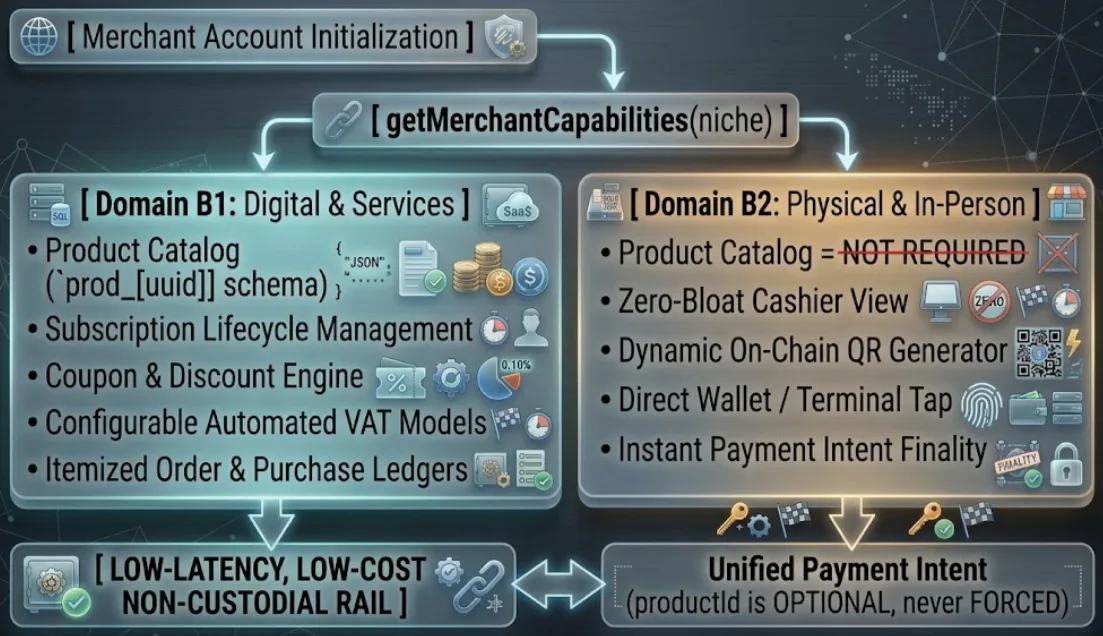
Traditional payment software frequently falls into the trap of monolithic assumptions. Platforms either build an exhaustive e-commerce dashboard packed with product variants, SKU tracking, tiered subscriptions, and tax tables—completely overwhelming a brick-and-mortar cafe cashier—or they build an ultra-minimal point-of-sale terminal that leaves SaaS founders with zero tooling for subscription billing, coupons, or developer API integrations.
In a global payment network, forcing every merchant into an identical data model creates severe operational friction. A street vendor or restaurant cashier tapping out an in-person charge must never be forced to navigate a "Create Product" wizard or configure recursive subscription renewal rules. Conversely, an enterprise software developer requires robust itemized billing (prod[uuid]), dynamic coupon redemptions, and granular webhook configurations.
To solve this duality without fragmenting into multiple unmaintainable codebases, modern infrastructure implements a Niche-Aware Capability Architecture.
The capability-driven architecture operates across three foundational design rules:
1.Centralized Capability Gatekeeping (getMerchantCapabilities):
Instead of hardcoding UI toggles or database forks across disjointed frontend components, feature availability is evaluated via a centralized capability matrix spanning 9 explicit merchant niches (DEVELOPER, FREELANCER, INFLUENCER, ONLINEBUSINESS, SMALLCOMPANY, ENTERPRISE, RETAIL, RESTAURANT, and POSPHYSICAL). The system queries the tenant’s capability flags to render only relevant operational surfaces.
2.The Zero-Bloat Physical Commerce Standard:
For physical commerce categories (RETAIL, RESTAURANT, POSPHYSICAL), the product catalog is completely disabled by default. A cashier opens a streamlined keypad or terminal link, enters a fiat/crypto nominal total, and the system instantly generates an atomic Payment Intent accompanied by a dynamic QR code. The merchant is never prompted for product names, inventory tracking, or subscription tiers.
3.Optionality at the Intent Layer:
At the core payment routing boundary, productId, orderId, and subscriptionId remain strictly optional parameters. A digital SaaS checkout binds a payment directly to proda98f12..., whereas an over-the-counter coffee purchase generates a valid on-chain payment intent with productId = NULL. Both settle on the exact same underlying Base L2 ledger with identical sub-second finality.
By decoupling merchant capabilities from underlying settlement rails, financial gateways deliver specialized, zero-friction workflows for retail operators while providing industrial-strength commerce tooling for digital enterprises.