Over the first five days of our series, we dismantled the legacy card processing monopoly, unified checkout declarations with the Universal Payment Intent, leveraged Base L2 for sub-cent gas economics, eliminated custodial reserves, and stabilized nominal pricing via real-time stablecoin oracles. Today, we step across the architectural boundary separating human e-commerce from the next trillion-dollar market: Machine-to-Machine (M2M) Commerce.
When Tim Berners-Lee and early internet architects designed the HTTP standard, they reserved HTTP Status Code 402: Payment Required for native digital cash settlement. Because the 1990s lacked decentralized, programmable, friction-free money, web monetization defaulted to ads, data harvesting, and centralized monthly credit card subscriptions.
In 2026, autonomous AI agents, automated ETL pipelines, and high-frequency software clients make traditional monthly SaaS subscriptions unviable. An autonomous agent querying a specialized vector database, requesting a zero-knowledge proof, or fetching live market telemetry cannot navigate human-centric payment walls: it cannot manually submit a credit card, solve CAPTCHAs, or commit to a $50/month recurring plan for a 1-second task.
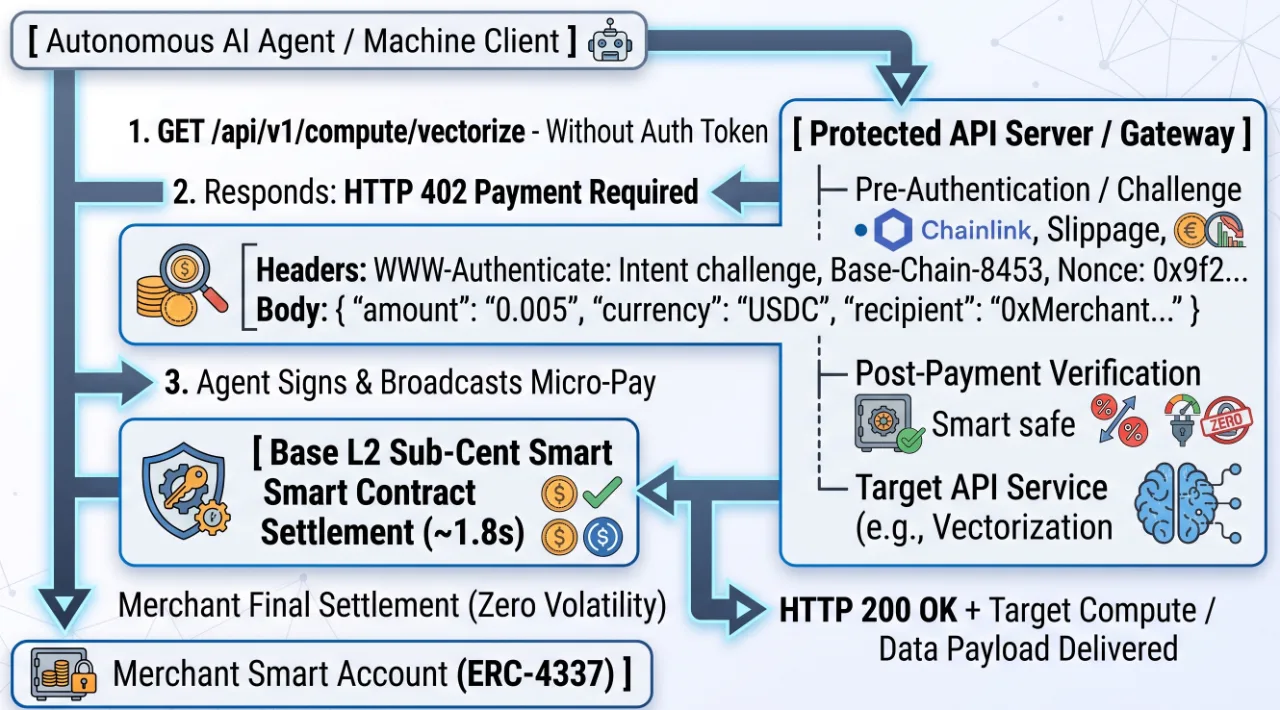
Modern API architectures solve this by reviving Native HTTP 402 Payment Negotiation.
The native HTTP 402 payment architecture functions across three core technical layers:
1. Deterministic Challenge-Response Negotiation:
When an unauthenticated machine client requests a protected endpoint, the server responds with an HTTP 402 Payment Required header instead of a static 401 Unauthorized. The response payload delivers a cryptographic payment challenge specifying the exact Base USDC amount (e.g., $0.005), recipient merchant address, chain ID (8453), and an idempotency nonce.
2. Pay-Per-Request Micro-Metering:
Rather than purchasing pre-funded API credit packs that tie up capital, agents pay atomically per request. Standard programmatic libraries (curl, Python requests, Axios, and fetch clients) inspect the 402 header, execute a sub-cent payment transaction from an ephemeral session key, attach the on-chain receipt hash to the retry request, and receive the data stream in milliseconds.
3. Zero-Account Machine Ergonomics:
The API provider does not need to maintain complex user registration databases, password hashing tables, or credit card billing profiles for machine callers. If an agent presents a cryptographically valid on-chain payment receipt matching the challenge nonce, access is granted instantly.
By implementing HTTP 402 on high-throughput Layer-2 rails, the web finally gains its native economic layer: machine-readable, trustless, and metered directly at the protocol level.