Over the first three days of our architectural deep dive, we analyzed how legacy gateways levy hidden fees, introduced the Universal Payment Intent schema, and examined how Base L2’s sub-cent gas economics make micro-transactions viable. Today, we confront the single most damaging operational constraint imposed on internet businesses: custodial holdbacks and rolling reserves.
In traditional acquiring infrastructure, payment processors act as custodial intermediaries. When a customer swipes a credit card, the merchant does not receive the funds directly. Instead, capital enters the processor’s omnibus balance sheet. Because card network rules allow retrospective disputes up to 120 days post-fulfillment, acquirers mitigate chargeback risk by imposing 5% to 20% rolling reserves held for up to six months. For an agile software team or high-growth startup, having 15% of gross revenue locked away creates an existential cash-flow drain.
The root cause is structural: legacy payment systems settle on a debt-promise ledger that requires centralized custody to manage risk.
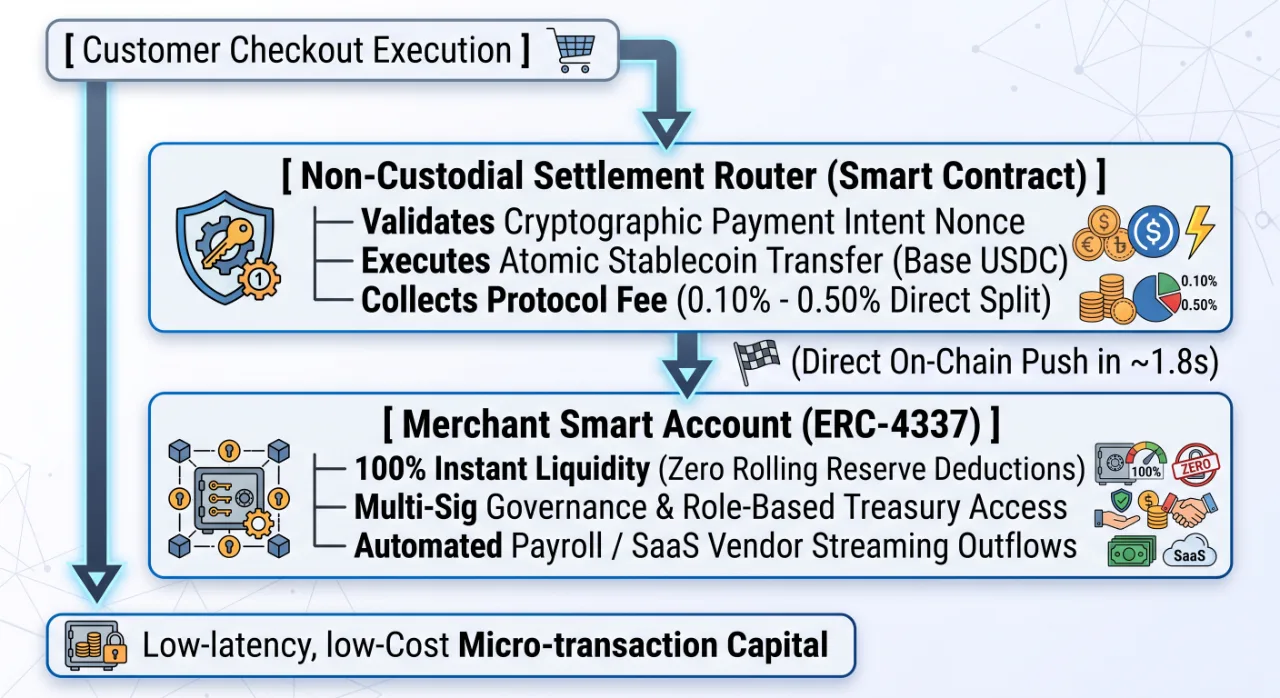
Modern decentralized payment architectures solve this at the protocol layer by replacing custodial clearinghouses with Zero-Reserve Non-Custodial Settlement into Smart Accounts.
A non-custodial zero-reserve architecture delivers three structural improvements:
1. Elimination of Third-Party Balance Sheet Exposure:
In a non-custodial framework, user funds never route into a gateway-owned bank account or pool. The payment smart contract acts merely as a stateless execution router: it validates the transaction intent and atomically transfers stablecoins directly to the merchant's smart account. If the gateway infrastructure goes offline, merchant revenue is entirely untouched on-chain.
2. Instant Operational Working Capital:
By bypassing the clearinghouse float, settled stablecoins (USDC) are immediately available to the merchant within ~1.8 seconds. This enables continuous capital velocity: merchants can instantly redeploy revenue into cloud infrastructure, developer payroll, or inventory procurement without waiting for multi-day batch payouts.
3. Programmable Cash-Flow Routing:
Because funds land directly in an ERC-4337 smart account, merchants can configure programmatic payout rules. Incoming revenues can automatically split into tax reserves, operational wallets, or team compensation streams in real time, turning the settlement address into an automated treasury engine.
By aligning payment execution with cryptographic custody, merchants retain 100% of their earned liquidity from the exact second a transaction confirms.