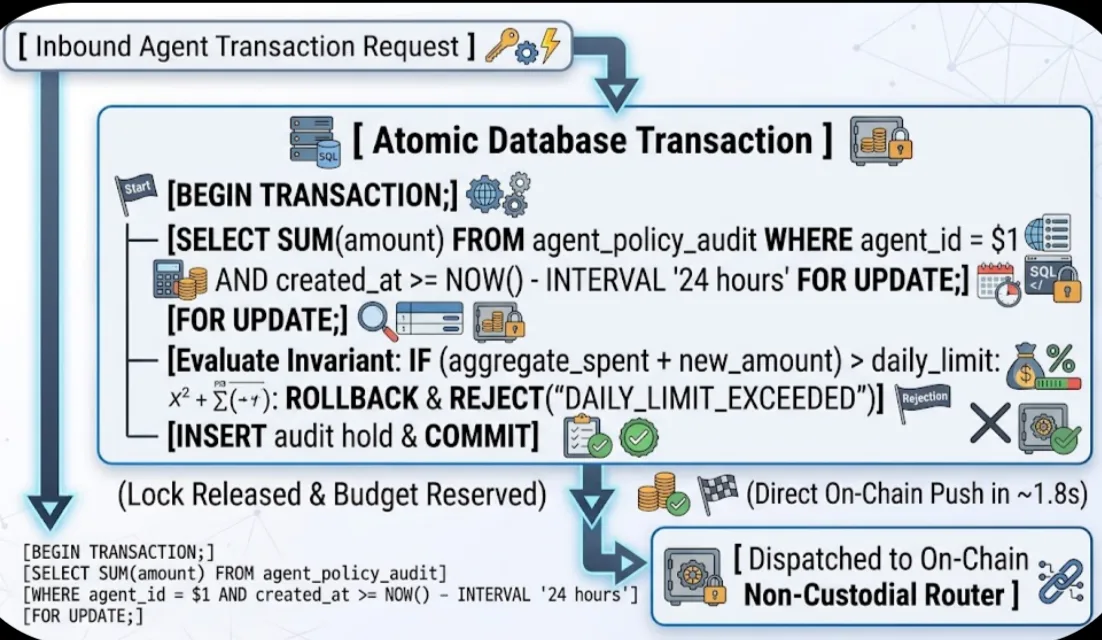
Over the first three days of our architectural series, we defended webhook pipelines against SSRF, enforced 4-byte function selectors with calldata parameter constraints, and bound session keys to ephemeral Time-To-Live (TTL) expiries. Today, we address a concurrency failure mode that can silently drain an enterprise balance sheet: race conditions in spending limits.
Autonomous AI agents do not transact sequentially like humans tapping cards at a checkout counter. An agent fleet may deploy dozens of asynchronous workers simultaneously to run automated arbitrage loops, batch-scrape paid data feeds, or provision serverless compute nodes. When multiple threads request funds within the same millisecond, standard application-level spending checks break down.
If your policy engine follows the classic pattern:
1.Read current daily balance from the database
2.Calculate if currentspent + requestamount <= dailylimit
3.Write the new transaction and update the ledger
...a race condition is mathematically guaranteed.
If the daily limit is $500 and the current aggregate spend is $450, two concurrent requests of $50 will both read the old balance ($450), both conclude that $500 does not breach the limit, and both dispatch payments. The agent successfully spends $550, completely violating the policy boundary.
To eliminate this vulnerability, production infrastructure enforces Concurrency-Safe Velocity Envelopes via Atomic Transactions and Row-Level Locking.
A concurrency-safe spending boundary relies on three critical architectural safeguards:
Pessimistic Row-Level Locking (FOR UPDATE):
1.Application-layer memory checks cannot protect against distributed multi-tenant workers. Spending evaluations must execute inside an ACID-compliant database transaction. By querying historical spend within the active window using an exclusive row lock (FOR UPDATE), subsequent parallel requests are forced to wait until the preceding transaction commits or aborts.
2.Rolling-Window Windowing Logic:
Unlike calendar-day limits that reset abruptly at midnight (creating artificial spending spikes), rolling-window limits track consumption over a sliding period (e.g., $250 within any continuous 1-hour window). Concurrency-safe aggregate queries dynamically sum valid ledger rows within NOW() - INTERVAL 'rollingwindow_seconds', ensuring that expired entries gracefully roll off without concurrency vulnerabilities.
3.Idempotent Budget Holds:
Before dispatching a transaction to the on-chain router or smart account, the policy engine establishes a temporary atomic budget hold. If the blockchain network drops the transaction or execution reverts, an automated reconciliation worker safely rolls back the reservation without permanently stranding capital.
Deterministic access control requires mathematical guarantees. By replacing naive read-calculate-write loops with atomic database locking, organizations can run fleets of parallel AI agents without fear of limit bypasses.