Yesterday, we deconstructed the hidden costs of legacy gateways: compounding interchange fees, rolling reserves, and multi-day payout delays. Today, we examine the foundational architectural primitive required to build an open, programmable payment network: The Universal Payment Intent.
In traditional web development, handling customer checkouts requires stitching together bespoke API endpoints, handling disparate card tokenization payloads, and managing fragmented state machines. When introducing autonomous software agents, background scripts, or machine-to-machine micro-transactions into the same architecture, legacy systems break down completely. Software bots cannot navigate browser-based 3D Secure challenges, solve CAPTCHAs, or input SMS one-time passwords.
To solve this, next-generation payment infrastructure decouples payment declaration (the intent) from financial settlement (the execution).
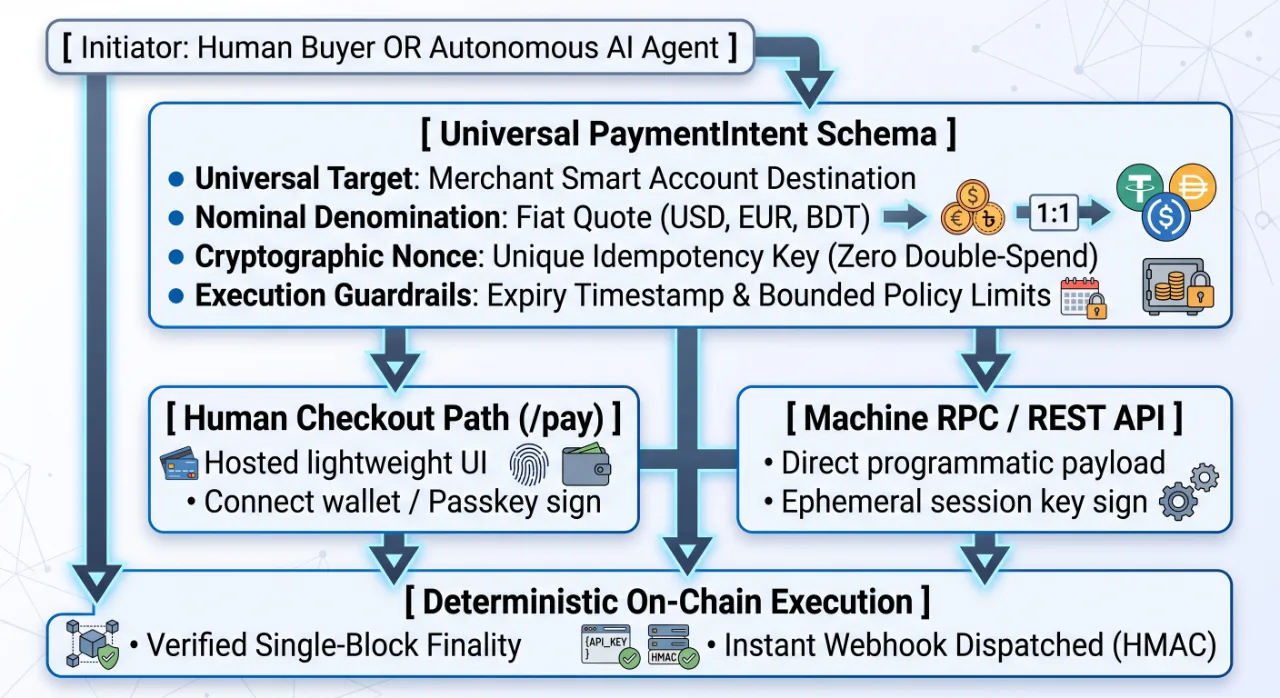
The Universal Payment Intent architecture operates on three core technical mechanisms:
1. Dual-Actor Intent Abstraction:
The underlying protocol does not care whether an order originates from a human clicking a button on a hosted checkout page (/pay) or an autonomous AI agent making an authenticated HTTP request. Both paths generate the exact same standardized PaymentIntent payload containing merchant identification, metadata, currency references, and cryptographic boundaries.
2. Deterministic Cryptographic Idempotency:
In distributed architectures and high-frequency autonomous agent workflows, network timeouts and dropped connections frequently trigger automated retries. The Universal Payment Intent embeds unique cryptographic nonces and idempotency keys directly into the payload. If an agent or client resubmits the same intent, the protocol identifies the duplicate and prevents double-charging at the smart contract level.
3.Multi-Currency Nominal Pricing with Fixed Settlement:
Merchants need to price products in their local or customers' home currencies (USD, EUR, GBP, BDT, INR, etc.) to maintain predictable accounting. The intent engine queries real-time, low-latency price feeds to compute the exact stablecoin equivalent at the precise second of intent creation. The customer or agent settles in pegged stablecoins, completely insulating the merchant's balance sheet from token volatility.
By treating payment intents as universal, self-contained cryptographic declarations, developers build a single payment pipeline capable of serving human consumers and autonomous software agents simultaneously.