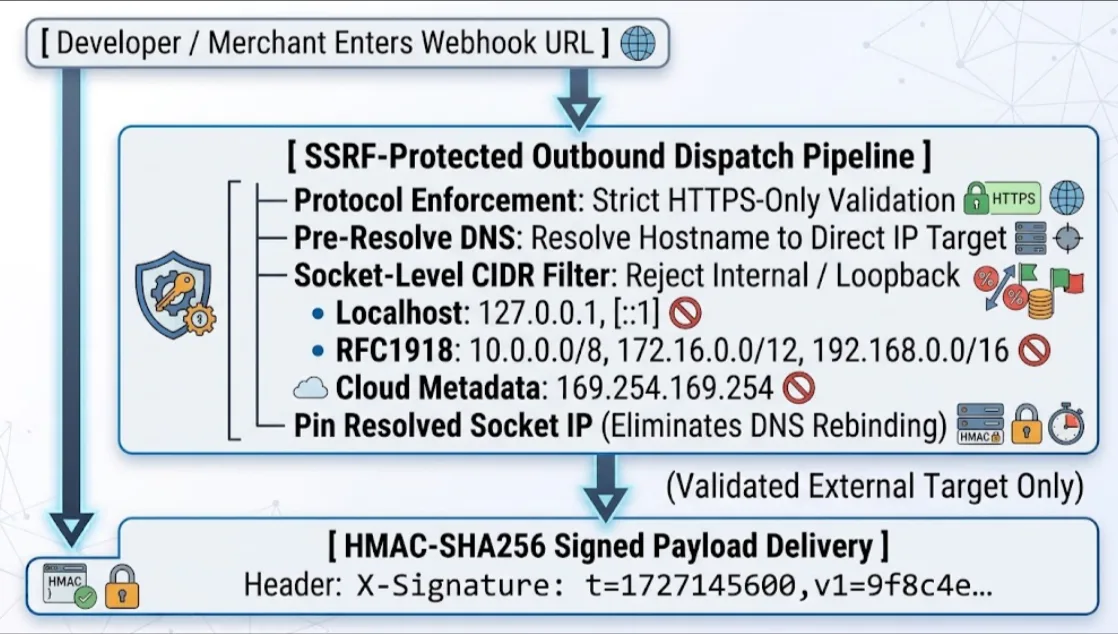
Modern financial protocols and payment gateways rely heavily on webhooks to notify external merchants and autonomous software agents the exact millisecond an on-chain payment intent confirms. To provide a high-grade developer experience, platforms provide interactive webhook testing consoles where developers can dispatch signed test payloads to arbitrary HTTPS endpoints.
However, accepting arbitrary destination URLs from users introduces a severe attack vector: Server-Side Request Forgery (SSRF).
If a webhook dispatcher is not hardened, an attacker can input internal network targets to probe internal microservices, access loopback endpoints, or query cloud metadata APIs (169.254.169.254) to steal ephemeral IAM tokens and environment secrets. Furthermore, sophisticated attackers utilize DNS Rebinding to bypass naive application-layer URL filters by altering DNS resolutions right between pre-flight validation and the actual HTTP payload dispatch.
A resilient, production-ready webhook testing and delivery pipeline requires three non-negotiable defensive layers:
Strict CIDR & Metadata Isolation:
1. The dispatcher must drop requests attempting to resolve to loopback blocks (127.0.0.0/8, ::1), RFC1918 private subnets (10.0.0.0/8, 172.16.0.0/12, 192.168.0.0/16), and link-local ranges (169.254.0.0/16). Cloud metadata services must be completely unreachable from any outbound webhook worker.
2. Eliminating DNS Rebinding (TOCTOU Defense):
Validating a domain once via standard DNS lookup before executing an HTTP client call introduces a time-of-check to time-of-use (TOCTOU) vulnerability. Attackers exploit this with low-TTL nameservers that flip to internal addresses upon the second lookup. The dispatch pipeline must resolve the hostname once, validate the resolved IP against CIDR rules, and force the underlying TCP socket connection directly to that specific IP.
3. Cryptographic Payload Signing:
Every test and production webhook must include an HMAC-SHA256 signature over the exact payload and timestamp header (t=timestamp,v1=signature). This enables legitimate external endpoints to verify provenance, eliminate tampering, and reject replayed event streams.
Hardening outbound developer tools ensures that external testing never compromises core infrastructure security.